
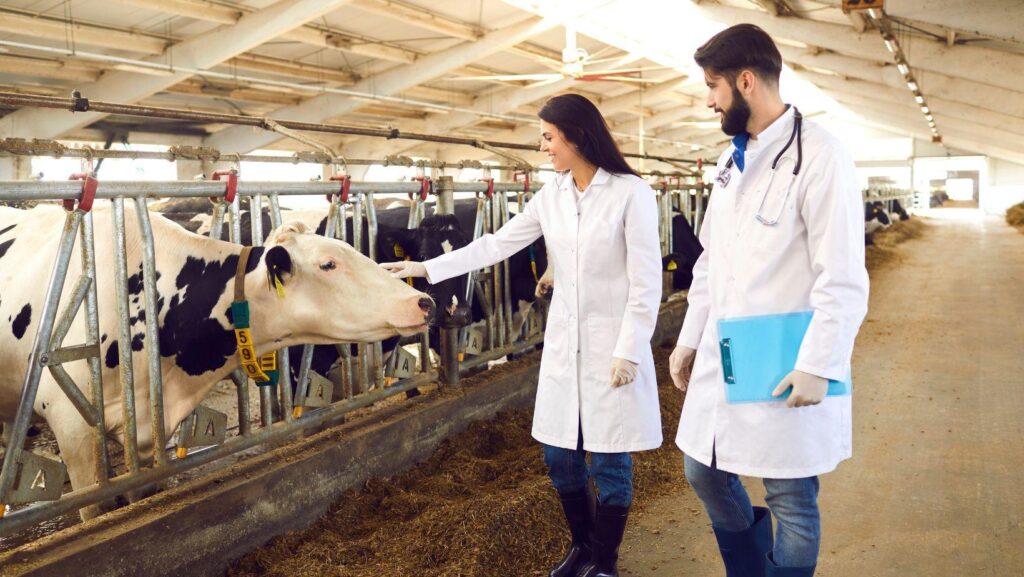
The welfare of farm animals is no longer an issue confined solely to the livestock sector, but has become a fundamental pillar of global public health protection. There is, in fact, a deep connection between the microbial ecosystem of the animal gut and the safety of the food that reaches our tables every day, a concept that finds its fullest expression in the ‘One Health’ approach, promoted by global health authorities.
This vision teaches us that our health mirrors that of livestock: a connection that manifests itself concretely within the animal’s digestive system. Here, a balanced microbiota acts as a genuine biological barrier against pathogens, preventing the proliferation of dangerous bacteria that could contaminate the food supply chain. Consequently, keeping the intestines of farmed animals healthy helps to reduce the use of drugs and antibiotics, ensuring safer and more natural animal products. Caring for a cow, a pig or a chicken through an informed choice of feed thus becomes the first step in protecting the health of the end consumer.
The dynamics governing the balance of the gut flora
The digestive system of animals is a complex biological system, populated by billions of bacteria that perform essential tasks, such as breaking down fiber and stimulating the immune system. However, this internal balance is extremely sensitive and can be disrupted by factors such as environmental stress caused by sudden changes in temperature and the natural physiological changes associated with growth stages.
Although individual genetics play a part, it is undoubtedly diet that determines the success of this ecosystem. Poorly managed dietary supplementation or a sudden change in diet can, in fact, upset the intestinal pH balance, favoring the proliferation of harmful bacteria at the expense of beneficial ones. Regarding this context, Vetagro’s research on feed additives has led to the development of specific solutions capable of stabilizing these fluctuations, providing farmers with scientific tools to protect their animals’ digestion even during the most critical and stressful periods of their life cycle.
Feeding strategies to nourish beneficial microorganisms
To prevent disease and promote healthy growth in animals, modern farmers are increasingly turning to feeding technologies that support the body’s natural defenses. By focusing on probiotics and prebiotics, microorganisms and fibers that work in synergy to inhibit the proliferation of harmful bacteria and actively stimulate the immune system, resulting in increased animal productivity. This biological shield is often complemented by the targeted action of organic acids and essential oils, substances capable of regulating the bacterial load in the small intestine whilst simultaneously promoting the development of intestinal villi.
By improving the integrity of these structures, the animal is able to assimilate every nutrient more efficiently, optimizing feed resources and ensuring a more sustainable and healthy production chain.
Targeted efficacy thanks to the microencapsulation of nutrients
One of the most complex challenges in animal nutrition concerns the ability of additives to reach their destination without being destroyed before they have performed their task. Many valuable substances, if supplied in the traditional way, risk being prematurely degraded by stomach acids, rendering them completely ineffective once they reach the intestine. To overcome this problem, science has introduced microencapsulation in animal nutrition, a cutting-edge technique that preserves active ingredients within a protective barrier, usually composed of plant-based fats. This coating allows for a gradual release of the contents throughout the digestive tract, ensuring that beneficial bacteria receive the necessary support exactly where pathogen pressure is highest.
Thanks to microencapsulation farmers can manage feed rations much more efficiently, reducing feed wastage and limiting the environmental impact, as a gut that functions well produces less waste and ensures greater sustainability across the entire supply chain.
An integrated vision for tomorrow’s food safety
It is clear that managing gut health on farms is a genuine prevention strategy. The ability to positively influence animal gut flora through feed represents, in fact, the cutting edge for those seeking to combine productivity with consumer protection. Using targeted and safe additives means embracing a vision of ‘circular health’ where animal welfare becomes the essential prerequisite for our own health.
Educating the market and supporting farmers in adopting these cutting-edge strategies is the only way to ensure that the protection of human life remains a constant commitment, one that begins with respect for digestive balance and is carried out daily in our homes through informed dietary choices.