A Route Shaped by Rivers and Empires
Central Europe has a way of revealing its history through ordinary streets. A grand railway station, a riverside boulevard or an ornate café can all point towards an era when royal courts, merchants and diplomats shaped the fortunes of the region.
A journey through Budapest, Vienna and Prague brings several of these stories together. Each city developed under different circumstances, yet all were influenced by the Habsburg world, shifting borders and the cultural exchanges that took place along the Danube and its surrounding territories.
The route is particularly rewarding for travellers interested in architecture. Baroque churches, nineteenth-century boulevards, medieval lanes and Art Nouveau details appear throughout the three capitals, creating a succession of remarkably varied urban scenes.
Budapest and the Danube
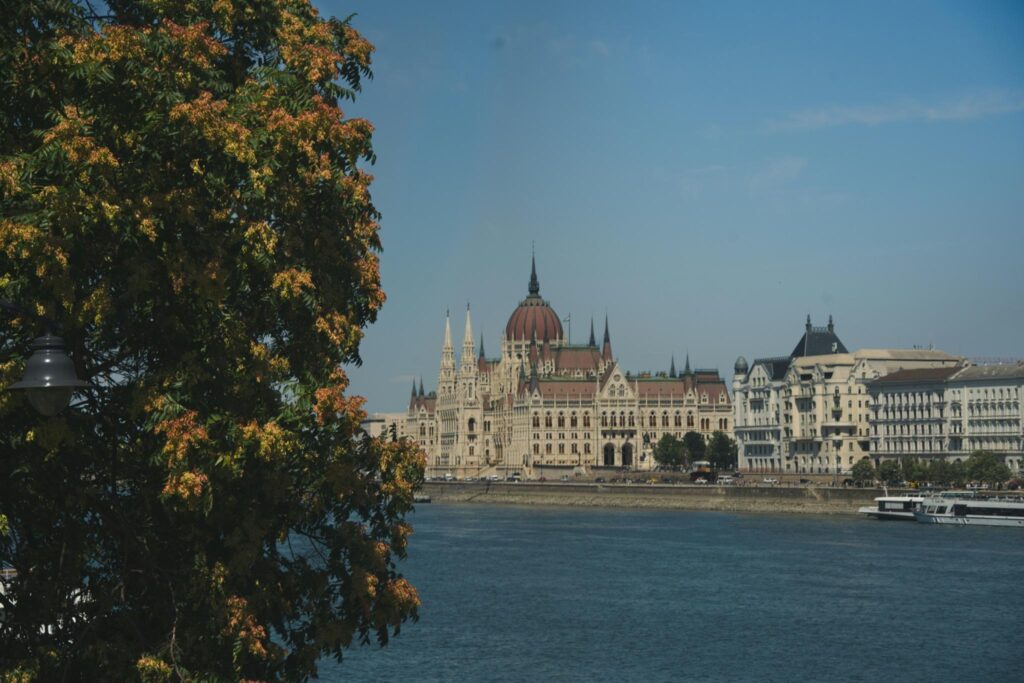
Budapest is best understood from the river that divides it. The Danube separates the hilly Buda side from the flatter Pest side, while bridges connect the two halves and create some of the city’s most memorable views.
The Hungarian capital grew from several historic settlements before becoming a major centre of the Austro-Hungarian Empire. Its grand avenues and public buildings reflect the confidence of the nineteenth century, when Budapest underwent rapid development.
Buda Castle occupies a prominent position above the river. From the surrounding Castle District, visitors can look across towards the Parliament building, whose elaborate Gothic Revival architecture dominates the Pest waterfront.
Fisherman’s Bastion provides another excellent viewpoint, with its pale stone towers and terraces overlooking the city. Nearby Matthias Church adds colourful roof tiles and a long history stretching back to the medieval period.
From Budapest Towards Vienna
The train from Budapest to Vienna offers a convenient connection between two capitals whose histories became closely intertwined under the Habsburg monarchy.
Leaving Budapest, the route follows a landscape that gradually moves away from the Hungarian capital and towards Austria. The journey itself provides a useful transition between two cultural environments, with Vienna eventually emerging as the former imperial centre of a vast multinational state.
Vienna’s architecture reflects that history on an impressive scale. The Ringstrasse forms a broad ceremonial boulevard lined with monumental buildings, including the Vienna State Opera, Parliament and Burgtheater.
The Hofburg complex provides perhaps the clearest expression of the city’s former imperial role. Different wings were constructed over several centuries, resulting in an enormous collection of courtyards, state rooms and museums.
Vienna’s Imperial Character
Vienna can sometimes feel like an open-air architectural archive. Gothic, Baroque, historicist and modern styles exist within a relatively compact central area.
St Stephen’s Cathedral is the city’s most recognisable religious landmark. Its distinctive patterned roof and towering spire have dominated the central skyline for centuries.
Belvedere Palace offers a different expression of imperial Vienna. The complex consists of two Baroque palaces surrounded by formal gardens, while its art collection includes works by Gustav Klimt.
Schönbrunn Palace lies further from the centre and was once the principal summer residence of the Habsburgs. Its extensive gardens and grand interiors provide an insight into the ceremonial life of the dynasty.
Yet Vienna is not solely a city of palaces. Its cafés, neighbourhood markets and residential streets give the capital a more relaxed personality once visitors move away from the major monuments.
Coffee, Cakes and Viennese Rituals
Vienna’s coffee-house tradition has become an important part of its cultural identity. These establishments historically served as meeting places for writers, artists, intellectuals and politicians.
Today, traditional cafés still provide an opportunity to slow down with a cup of coffee and a slice of cake. Sachertorte is the most famous example, although the city’s pastry culture extends to apple strudel, Topfenstrudel and other regional specialities.
The ritual is as important as the menu. A Viennese café encourages lingering rather than rushing through a meal, making it a natural complement to a day spent exploring museums and historic streets.
Vienna’s food culture also extends beyond desserts. Schnitzel, tafelspitz and sausages remain familiar staples, while contemporary restaurants have introduced new interpretations of Austrian cuisine.
Art Nouveau and the Secession
Vienna’s imperial architecture is only one part of its visual identity. Around the turn of the twentieth century, artists and designers began challenging traditional academic styles.
The Vienna Secession building, with its distinctive dome of gilded laurel leaves, became a symbol of this artistic movement. Gustav Klimt and other members of the Secession sought greater freedom from established institutions.
The movement’s influence can also be seen in residential buildings, furniture and decorative arts throughout the city.
The contrast between the monumental architecture of the Ringstrasse and the more experimental work of the Secessionists reflects Vienna’s transition from imperial capital to modern cultural centre.
Across the Border to Bohemia
The Vienna to Prague train connects two cities that once belonged to the same imperial sphere but developed distinct cultural identities.
Prague sits along the Vltava River and possesses one of Europe’s most recognisable historic centres. Unlike Vienna’s broad ceremonial avenues, the Czech capital often feels more intimate, with winding lanes, compact squares and buildings from many different periods.
The Old Town Square forms the centre of the historic district. The Astronomical Clock adorns the Old Town Hall, while the Church of Our Lady before Týn provides a dramatic Gothic backdrop.
Crossing the Charles Bridge offers one of the classic Prague experiences. Statues line the bridge, while views extend towards the castle district and the riverbanks.
Prague Castle Above the City
Prague Castle rises above the Vltava and has been at the heart of Czech political life for centuries. The complex contains palaces, churches, courtyards and gardens rather than a single isolated building.
St Vitus Cathedral dominates the skyline. Its Gothic towers and stained-glass windows demonstrate the scale and ambition of medieval Prague.
The Golden Lane offers a smaller-scale experience. Tiny historic houses line a narrow passage within the castle complex, providing a contrast with the monumental buildings nearby.
From the castle terraces, the city unfolds below in a mixture of red-tiled roofs, church towers and modern structures. The view demonstrates how Prague has retained much of its historic form despite centuries of change.
Bohemian Streets and Modern Life
Prague’s historic centre can be busy, but quieter districts reveal a different side of the city.
Vinohrady is known for elegant apartment buildings, leafy streets and cafés, while Holešovice has developed a strong reputation for contemporary art, design and independent businesses.
The Czech capital also has a long literary tradition. Franz Kafka is perhaps its most famous literary figure, and references to his life and work appear throughout the city.
Beer is another important part of local culture. Czech brewing traditions stretch back centuries, and pubs remain central meeting places for residents.
Traditional dishes such as svíčková, goulash and dumplings provide a hearty introduction to Czech cuisine, particularly during the colder months.
The Danube’s Cultural Reach
The Danube provides an underlying connection between several Central European cultures. It passes through or near numerous historic cities before eventually reaching the Black Sea, linking communities that have long exchanged goods, ideas and artistic influences.
Budapest’s relationship with the river is particularly direct, with major landmarks positioned along both banks. Vienna’s development was also strongly connected with the Danube, although much of the modern city centre lies some distance from the main river channel.
The waterway’s importance was never purely scenic. It served as a commercial route, a strategic frontier and a means of communication between different parts of Europe.
Following the river’s cultural trail helps explain why the region contains such a mixture of languages, architectural traditions and culinary influences.
Palaces, Music and Performance
The royal heritage of Central Europe remains visible in its performing arts. Vienna’s opera houses and concert halls continue traditions associated with composers such as Mozart, Haydn, Beethoven and Schubert.
Budapest has its own impressive musical institutions, including the Hungarian State Opera House, whose ornate interior reflects the city’s nineteenth-century ambitions.
Prague’s musical identity is equally strong. The National Theatre and Rudolfinum remain important venues, while the city’s connection with Antonín Dvořák and Bedřich Smetana forms part of its cultural heritage.
Music therefore provides another thread linking the three capitals, even though each has developed its own repertoire and traditions.
A Journey Through Changing Eras
Budapest, Vienna and Prague can be read almost like successive chapters in Central European history. Budapest reveals the ambitions of a rapidly developing nineteenth-century capital, Vienna presents the grandeur of the Habsburg court, and Prague combines medieval heritage with the cultural confidence of modern Bohemia.
The differences become especially apparent when travelling between them. Architectural styles shift, languages change and local food traditions become more pronounced.
Yet the similarities are just as striking. All three cities have grand public spaces, historic cafés, impressive concert traditions and rivers that have influenced their development.
Where Empire Meets Everyday Life
The most interesting aspect of this journey may be the way imperial history remains woven into ordinary urban life. Former palaces now house museums and government institutions, old market areas continue to serve local communities, and historic streets are filled with modern restaurants, shops and cafés.
Central Europe’s royal past is therefore not confined to grand monuments. It survives in city plans, public squares, railway routes and cultural traditions that continue to shape the region.
From the Danube embankments of Budapest to Vienna’s imperial avenues and Prague’s Bohemian lanes, the journey offers a rich succession of architectural and cultural experiences.
Travelling between these capitals reveals a region where borders have shifted repeatedly, but where artistic traditions, rivers and historic connections have continued to bind neighbouring societies together. The result is a route that feels both deeply historical and unmistakably alive in the present.